Issue 3 | From Concerns to Solutions: An Executable, Verifiable and Accountable China–Canada Integrated Delivery System


Deepening the Connection Between China’s Whole-Home Customization Supply Chain
and the Toronto Market
R-Vision Global Insights
The first two articles introduced the completeness of China’s whole-home customization supply chain and the design freedom, product diversity, cost efficiency and integrated solutions that this industrial capability can bring to the Toronto market. However, once a project enters the execution stage, all participants—whether China-based designers, factories, supply-chain and logistics service providers, or Canada-based homeowners, designers, cabinet and furniture manufacturers, developers, contractors and builders, renovation companies and installation teams—raise more specific questions: Can the total project cost be controlled? Can the design actually be built? Are product quality and environmental performance reliable? Is the delivery period too long? Will cross-border communication become distorted? Can the products be installed smoothly after arriving in Toronto? And who will take responsibility if a problem occurs?
These concerns are entirely reasonable and should not be avoided through simple price comparisons or verbal promises. For cross-border whole-home customization to be genuinely accepted by the Toronto market, every concern must be converted into a concrete solution mechanism, with a clearly identified responsible party and a verifiable method of confirmation.
Our basic operating logic is as follows: R-Vision Global is responsible for the overall operation, coordination and management of the project; the R-Vision Global China Design Studio team is responsible for design development and coordination with production; the R-Vision Global China Supply Chain Organization and Quality Management team is responsible for supplier selection, production, quality inspection, packaging and export; the R-Vision Global International Trade and Logistics Coordination team is responsible for domestic consolidation in China, customs declaration, ocean freight, customs clearance and inland transportation in Canada; and the R-Vision Global Toronto Construction, Installation and After-Sales team is responsible for site verification, pickup, installation, delivery and after-sales service. The five teams work around the same drawings, the same standards, the same project schedule and the same final result, creating a complete closed loop of responsibility.
I. How R-Vision Global Addresses the Pain Points and Concerns on the China Side
Issue 2 explained that China does not lack design, material, manufacturing or logistics capabilities. What is truly missing is a stable entry point to local Canadian projects, accurate site information, a unified organizational structure, and clear responsibility for installation and after-sales service after the products leave China. The solution presented in this issue is to bring every professional capability on the China side, through R-Vision Global, into the same Toronto project-delivery system.
1. China Design Studio: From Remote Drafting to Collaborative China–Canada Design Development
Chinese design teams possess strong capabilities in visual presentation, design development and production conversion. However, because they are far from Toronto clients and project sites, they often lack direct experience with local lifestyles, building structures, appliance locations, construction practices and installation conditions. R-Vision Global’s solution is for R-Vision Global and the local designer to jointly complete client-requirement collection, client relationship management, site measurement, concept design, site documentation and professional assessment. The Chinese design team then completes design development, technical detailing, material coordination, production drawings and installation drawings. The Chinese design team no longer works from remote assumptions, but from confirmed local data.
Key dimensions, appliance locations and construction details must be reviewed before production. Any modification affecting production is centrally recorded by R-Vision Global, and the latest version is formally issued to prevent outdated drawings from continuing to circulate.

Figure 1 | China and Canada teams jointly review the developed kitchen design: site dimensions, appliance locations and key details are reconfirmed before production
2. Chinese Whole-Home Customization Factories: From Isolated Supply to a Stable Project Interface
Chinese factories can manufacture with high precision, but they cannot conduct final site measurements in Toronto and may find it difficult to adapt separately to the working methods of different clients, designers and installation teams. R-Vision Global provides factories with one unified project interface: unified site data, production drawings, material standards, packaging identification and delivery schedules. The factory only needs to organize production according to the finally approved documents. The R-Vision Global China Supply Chain Organization and Quality Management team tracks production scheduling, conducts quality inspections and coordinates shipment. After the products arrive in Canada, the R-Vision Global Toronto Construction, Installation and After-Sales team continues to take responsibility. As a result, the factory receives not merely a one-time fragmented order, but a repeatable and sustainable mechanism for cooperation on Canadian projects.
3. Chinese Material and Specialized-Category Suppliers: From Individual Products to Complete Project Coordination
Suppliers of panels, stone, doors and windows, lighting, hardware, furniture, storage systems, soft furnishings and light smart-home products often have their own strengths. However, when entering the Canadian market independently, they face small order volumes and high communication costs, and they cannot independently coordinate colours, dimensions, interfaces and installation sequences across the entire project. R-Vision Global begins with the complete spatial solution and then divides the project into clearly defined tasks for each specialized supplier. Different suppliers work to the same colour system, dimensional reference, detailing requirements and delivery schedule, allowing individual products to form one coordinated and complete space.
4. China Supply Chain Organization Team: From an Accumulation of Resources to Unified Project Management
The real challenge in China’s supply chain is not a shortage of factories, but the enormous number of factories and the significant variation in their capabilities. Over many years, the R-Vision Global China Supply Chain Organization team has built a highly extensive and reliable supplier network across every segment of China’s home-furnishing industry and has established a comprehensive database of suppliers and competitive products. Integrating the China–Canada whole-home customization supply chain requires multiple factories, multiple product categories and multiple document versions to advance simultaneously and collaboratively. For each project, we create a unified project information package that manages the final drawings, material approvals, product identification, revision records, production milestones, quality-inspection requirements, packaging methods and container-loading plan. Site changes are released only through one formal channel, preventing one party from already entering production while another party is still making revisions.
5. International Trade and Logistics Providers: From Segmented Transportation to a Continuous Delivery Chain
Whole-home customization shipments involve multiple sources, complex customs classifications, different dimensions and varying levels of fragility. Domestic consolidation, packaging, export declaration, ocean freight, customs clearance, Toronto pickup and site delivery must therefore be organized as one continuous process. The international trade and logistics coordination teams selected by R-Vision Global have many years of operational experience. They understand both policy and business practice and are reliable partners proven through years of cooperation. We use one unified cargo list and packaging-identification system across all stages, while the Toronto team prepares in advance for receiving, inventory checking and installation. The logistics provider deals with one clearly identified project entity rather than multiple unrelated factories and an unclear overseas consignee.
6.Results for the China Side

II. How R-Vision Global Addresses the Pain Points and Concerns on the Canada Side
Canadian participants want access to the product diversity, craftsmanship, total-cost advantages and production efficiency of China’s supply chain, but they are also concerned about quality, compliance, lead times, installation, after-sales service and client relationships. R-Vision Global has never intended to replace local professional teams. Our role is to serve as a back-end service platform for our partners, complementing, coordinating with and supporting one another. Throughout the cooperation process, we also share our own client resources with Canadian partners. Mutual benefit and shared success have always been central to our company’s operating philosophy.
1. Architects and Interior Designers: Expanding the Boundaries of Design Realization
Toronto designers understand their clients and the local market, but complex curves, irregular millwork, special finishes, multi-material combinations and highly customized products are often constrained by local equipment, supply availability and cost. R-Vision Global respects the local designer’s concept design, client relationship and project leadership. Using the China Design Studio and supply chain as back-end support, we complete design development, complex fabrication and multi-category coordination. We do not bypass the cooperating designer to contact their client. This allows designers to save time and devote more energy to developing new products and new clients.
Toronto designers may also be concerned about whether they can communicate and work seamlessly with Chinese designers and suppliers. AI translation software and meeting-minutes functions are now highly mature, making barrier-free professional communication between the teams entirely achievable.

Figure 2 | Transync AI simultaneous-translation software: supports real-time translation, meeting recording and meeting-minute preparation for China and Canada teams, making cross-border technical communication smoother
2. Cabinet and Furniture Manufacturers: Supplementing Capacity, Craftsmanship and Product Lines
Local manufacturers understand Canadian standards and clients, but they face pressure from facility costs, labour expenses, equipment investment and limited product lines. R-Vision Global can supplement products that local manufacturers cannot produce economically, including complex cabinet doors, irregular millwork, metal-and-glass combinations, stone, lighting, light smart-home systems, storage solutions, supporting hardware, furniture and soft furnishings. The local company retains its brand, contracts, client relationships and on-site services, while R-Vision Global provides back-end design development, production, procurement, logistics and installation support. The parties may also work together to develop new clients.
3. Contractors and Renovation Companies: One Unified Supply-Chain Interface
Contractors and renovation companies must control total cost and construction schedules, but under the traditional model, the drawings, tolerances, lead times and installation requirements of different suppliers are often inconsistent. R-Vision Global uses one set of project drawings and one schedule to coordinate Chinese design, factories, quality inspection, transportation and Toronto installation. Contractors and renovation companies do not need to screen Chinese suppliers themselves or separately manage payment, quality, customs declaration, customs clearance and after-sales matters. They only need to coordinate with one project-management entity.
4. Real Estate Developers and Volume Projects: Achieving Standardization and Differentiation at the Same Time
Developers want to control budgets and stabilize quality and delivery while improving the project’s market positioning and differentiation. R-Vision Global can establish a modular product system by building, floor, unit type and upgrade option. Shared components are standardized for production, while cabinet doors, colours, hardware, storage and soft furnishings retain differentiated choices. Production and transportation can be completed in batches in China, while the Toronto team receives and installs products according to construction milestones, reducing one-time inventory and pressure on the site.
5. Installation Teams: From Final-Stage Involvement to Early Participation
Installation teams often first encounter the products only after the shipment arrives, turning front-end errors directly into high labour and rework costs in Toronto. The R-Vision Global Toronto Construction, Installation and After-Sales team participates in reviews during the measurement, design-development and product-breakdown stages, confirming walls, pipes and wiring, equipment, access routes and installation sequences in advance. Products are identified by floor, room, area and installation sequence, and installers work from the same set of drawings.

Figure 3 | Toronto project construction site: structure, pipes and wiring, equipment locations and actual dimensions are verified before design development and production
6. Homeowners and End Clients: Answering Their Most Practical Concerns with Clear Standards
(1) How Is the Total Cost Controlled?
Vision Global does not promote a project on the basis of a low unit price. Instead, we calculate the final total cost across design, production, packaging, transportation, customs clearance, delivery, installation and after-sales service. Unified procurement, transportation and installation across multiple product categories can reduce the hidden costs created by repeated communication, repeated site mobilization, missing-item replacements and rework. In one sentence, by using the complete Chinese supply chain, clients can receive greater real value within the same procurement budget they would otherwise spend in Canada.
(2) How Can Clients See and Feel the Quality?
Clients do not need to rely only on verbal promises. R-Vision Global has already brought commonly used Chinese panel, finish and paint-colour samples to Toronto. Clients, designers and partners can inspect the panel substrate, thickness, surface texture, colour and feel in person and use the selected samples as the basis for comparison during subsequent production. Stone, lighting, fabrics, furniture, soft furnishings, hardware, special finishes and irregular products can first be confirmed through factory photographs and videos, partial prototyping and mailed samples. To help clients experience the actual effect of the products, we can also arrange visits to real Toronto projects for which we serve as the general contractor.
Quality inspection is likewise translated into concrete actions: confirming samples and final drawings before production; inspecting first-piece dimensions, edge banding, finishes and structure during production; checking appearance, function, quantity and identification before the products leave the factory; inspecting packaging reinforcement before container loading; and conducting another inventory check and recording the installation results after arrival in Toronto. Clients see samples, photographs, videos, checklists and actual project sites—not merely an abstract statement that “there is no problem with the quality.”

(3) How Are Environmental and Suitability Requirements Confirmed?
For panels, paint, adhesives and other interior materials, product parameters, test documentation and supplier documents are reviewed according to project requirements. Existing panel and finish samples in Toronto are available for clients to inspect in person. Once a specific product is selected, its sample number, colour, material description and supporting documents are added to the project file. Lighting, surveillance, electrical and smart devices, as well as fire- or safety-related products, are reviewed before procurement to confirm whether they are suitable for Canadian projects. R-Vision Global does not make a blanket promise that every product “automatically complies.” Instead, clients are shown the specific materials, samples and documents before deciding whether to use them.
(4) How Can Clients Have Confidence in the Delivery Schedule?
The delivery period is calculated from the date on which the final production documents and drawings are confirmed and the factory formally begins production, until the goods arrive in Toronto and local pickup and delivery are completed. The following durations are planning benchmarks for a standard project. A written project schedule will be prepared according to product complexity, factory production scheduling and vessel schedules.
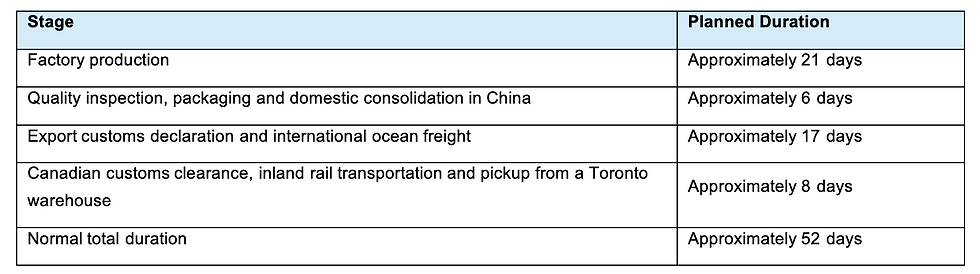
If customs inspection, port congestion, extreme weather, vessel-schedule adjustments or major design changes after production begins occur, the overall schedule may be extended by approximately 7 to 15 days. As a general risk allowance, the maximum period is planned at approximately 67 days. Throughout the full-chain service period, R-Vision Global and the client update the key milestones together: initial design, mid-stage design, final design-drawing approval, production launch, mid-production inspection, production completion, packaging and container loading, port departure, port arrival, customs clearance and Toronto pickup. Particularly during international transportation, we share tracking systems such as 17TRACK with the client, so the client is not left waiting passively and can always see which stage the project has reached.

Figure 4 | 17TRACK international logistics tracking system: shares transportation milestones and tracking progress, enabling clients to understand the project’s logistics status in a timely manner
(5) Who Is Responsible for Transportation, Installation and Problem Resolution?
Products are identified by room, area and installation sequence. After arrival in Toronto, the R-Vision Global Toronto Construction, Installation and After-Sales team completes the inventory check, delivery, installation and issue registration. If any problem occurs, R-Vision Global first assumes unified responsibility for receiving and handling the issue, and then coordinates internally according to whether the cause arose from design, production, transportation or installation.

Figure 5 | R-Vision Global Toronto team: responsible for product installation and subsequent after-sales service
7. Results for the Canada Side

III. How R-Vision Global Addresses the Core Fragmentation of Cross-Border Whole-Home Customization
Issue 2 pointed out that the central problem is not that any particular stage lacks capability. Rather, people are working at every stage, but no one organizes design, measurement, materials, production, transportation, installation and after-sales service into one organic and continuous result. R-Vision Global’s solution is not to add another intermediary, but to establish a unified project-management system.

Through practical project experience, R-Vision Global has developed a set of practical working standards and guidelines. Each team strictly performs its own duties and follows the applicable rules:
a. Working Standards and Guidelines for the R-Vision Global China Design Team
b. Working Standards and Procedures to Be Followed by the R-Vision Global China Supply Chain Organization Team in Production, Quality Inspection, Packaging and Consolidated Shipping
c. Working Standards, Procedures and Division of Responsibilities for R-Vision Global Toronto Renovation, Installation and After-Sales Services
d. Template of the “Complete Customization General Contracting Agreement” between R-Vision Global and the Client
e. R-Vision Global Directory of Chinese Whole-Home Customization Suppliers and Products
f. R-Vision Global Standards for Client and Project-Management Records
g. Template of the “Project Execution Cooperation Agreement” between R-Vision Global and Domestic and International Coordinating Parties
h. R-Vision Global Compliance Document Compilation
i. Summary of Key Canadian and Ontario Construction-Industry Regulations and Specific Working Standards
j. Key Laws and Regulations Governing Cross-Border Trade between China and Canada; International Freight Operating Procedures and Emergency-Response Mechanisms; Consolidated Import and Export Tariff Classifications for Major Product Categories; and Calculation Standards and Detailed Operating Guidelines for Customs Clearance in Both Countries
IV. From Delivery to After-Sales Service: Project Records, Tiered Resolution and Two-Layer Protection
A cross-border project cannot end immediately after installation is complete. The speed of after-sales resolution depends on whether responsibility was defined in advance, whether project documentation is complete and whether there is one unified point of contact for issues. R-Vision Global establishes the delivery and after-sales framework at the beginning of the project, rather than searching for a responsible party only after a problem arises.
1. A Traceable Record for Every Project
The project file includes site measurements, final drawings, material and colour approvals, product identification, traceable QR codes, revision records, production and quality-inspection photographs, packaging and container-loading lists, transportation documents, arrival inventory records, installation records, acceptance records, and subsequent repair and replacement-part records. If a problem occurs, the product location, dimensions, materials, supplier and original approved information can be identified quickly.
2. Unified Intake and Tiered Resolution of After-Sales Issues

3. Two-Layer Commercial Insurance and Transportation-Risk Protection
The first layer of protection is appropriate high-limit commercial liability insurance maintained by R-Vision Global as the local Canadian entity responsible for project operation, coordination and delivery. The second layer is the independent insurance and necessary qualifications maintained by the partners that actually perform project construction, installation or specialized subcontracting, according to their scope of work. Cargo transportation insurance may also be arranged for high-value or fragile cross-border goods according to the project. Insurance does not replace quality management or after-sales responsibility; rather, it provides additional protection, beyond normal project management, for major losses and third-party liabilities that meet the applicable insurance conditions.
V. Conclusion: Addressing Every Concern and Creating a Complete Closed Loop of Responsibility
Issue 2 presented, one by one, the pain points and concerns on the China side, the Canada side and within cross-border cooperation. The answers in Issue 3 must correspond to them one by one. The China side needs access to local Canadian clients, accurate site information and final-delivery capability; R-Vision Global provides one unified project interface and a locally responsible team. The Canada side needs China’s design-development capability, production craftsmanship, product range and cost efficiency, while requiring quality, delivery, installation and after-sales service to remain controllable; R-Vision Global provides unified standards and full-process management. The most dangerous fragmentation in the middle is reconnected through unified drawings, standards, schedules, communication, quality inspection, logistics, installation and responsibility.
R-What R-Vision Global truly provides is not a collection of products manufactured in China, nor a single international shipment. It is a China–Canada integrated delivery system extending from client requirements, design development, material organization, factory production, quality inspection, packaging and logistics, to Toronto installation, project documentation, after-sales resolution and insurance protection. Every concern has a corresponding mechanism, every critical milestone has a responsible team, and every final result has a clearly identified local responsible party. This capability allows every client to verify and evaluate, item by item, every completed project delivered through R-Vision Global.
Next Issue
Issue 4 | R-Vision Global Builds Its Own Core Partner Team Through Proven, Completed Projects
Vision Global’s two whole-home customization projects in Toronto are being advanced through the complete Chinese supply chain and are expected to be delivered around October. Through these two real projects, we will further verify the China–Canada integrated delivery system and work to establish core partners in Canada—including designers, cabinet and furniture manufacturers, builders, developers and renovation companies—who can cooperate with R-Vision Global on a stable, long-term basis.
Author: Nico Zhao
President, R-Vision Global


留言